Greetings, fellow readers! So last week, I went a little Venn Diagram crazy on you, and I thought I'd make it up to you by keeping this post a little more . . . linear, shall we say. I made a timeline of the important moments in my life for a class project; it's not a blog post per se, but it should keep you busy while I get some more reading done. Enjoy!
Until next time,
Anna
Sunday, February 1, 2015

Tuesday, January 20, 2015
Nerd, Geek, Dork
Greetings, fellow readers! Many of you have approached me with questions about the video I posted earlier this week: why did you make this video? How come you and your roommate have such good chemistry on screen? Where can I get Shakespeare socks like yours? Can I have your autograph?
Ok, that last one isn't true, but I will do my best to assuage your curiosity on the previous counts. As I have mentioned before, my roommate Allison is one of my best friends and a person I consider a member of my family. She and I were randomly assigned roommates in the Honors dorm at UF our freshman year, and we've been living together, thick as thieves ever since then (going on three years, woo hoo!)
The Shakespeare socks are from the internet (where else?) and of course, you may have my autograph, preferably on the frontispiece of my Pulitzer Prize-winning novel, release date TBD.
But Anna, I can hear you asking, what about the most important question, the one which holds the key to all the mysteries of life: why did you make this video in the first place? Patience, young padawans. You will learn when you are ready.
As I have mentioned before, I am taking a one credit (fun credit, really) class called Talk Nerdy to Me, and our first project was to make a vlog about when we became a nerd. Blessed with both beauty and talent, not to mention excellent chemistry, Allison and I decided to make this video together, little knowing what a hit it would be.
Fast forward a bit and you'll find me today in the midst of a conversation with my friend Sean about what it means to be a nerd, specifically as distinct from being a geek or a dork.
Like any word nerd worth her salt, I decided to begin by looking it up in the Oxford English Dictionary, which defines a nerd as "An insignificant or contemptible person, one who is conventional, affected, or studious; a 'square,' a 'swot.'" The first recorded incidence of the word "nerd" was in the 1950 picture book If I Ran the Zoo by Dr. Seuss, who wrote, "And then, just to show them, I'll sail to Ka-Troo And Bring Back an It-Kutch, a Preep and a Proo, a Nerkle, a Nerd, and a Seersucker, too!"
Despite this delightful lilting lyric, I do not think of myself as either insignificant or contemptible, so I moved on to the word "geek," which predates "nerd" by at least fifty years, appearing for the first time in the late nineteenth century. Alas, the dictionary informed me that a geek is "an unfashionable or socially inept person." "Dork" didn't give me too much luck either--it is defined as "a dull, slow-witted, or socially inept person" and derives from an American slang term for "penis" in the 1960's.
With pejoratives on the brain, I at last hearkened to that great fount of internet knowledge, the webcomic xkcd, whose author constructed a very helpful Venn diagram for those of us who care about our stance on these issues:


Ok, that last one isn't true, but I will do my best to assuage your curiosity on the previous counts. As I have mentioned before, my roommate Allison is one of my best friends and a person I consider a member of my family. She and I were randomly assigned roommates in the Honors dorm at UF our freshman year, and we've been living together, thick as thieves ever since then (going on three years, woo hoo!)
The Shakespeare socks are from the internet (where else?) and of course, you may have my autograph, preferably on the frontispiece of my Pulitzer Prize-winning novel, release date TBD.
But Anna, I can hear you asking, what about the most important question, the one which holds the key to all the mysteries of life: why did you make this video in the first place? Patience, young padawans. You will learn when you are ready.
As I have mentioned before, I am taking a one credit (fun credit, really) class called Talk Nerdy to Me, and our first project was to make a vlog about when we became a nerd. Blessed with both beauty and talent, not to mention excellent chemistry, Allison and I decided to make this video together, little knowing what a hit it would be.
Fast forward a bit and you'll find me today in the midst of a conversation with my friend Sean about what it means to be a nerd, specifically as distinct from being a geek or a dork.
Like any word nerd worth her salt, I decided to begin by looking it up in the Oxford English Dictionary, which defines a nerd as "An insignificant or contemptible person, one who is conventional, affected, or studious; a 'square,' a 'swot.'" The first recorded incidence of the word "nerd" was in the 1950 picture book If I Ran the Zoo by Dr. Seuss, who wrote, "And then, just to show them, I'll sail to Ka-Troo And Bring Back an It-Kutch, a Preep and a Proo, a Nerkle, a Nerd, and a Seersucker, too!"
Despite this delightful lilting lyric, I do not think of myself as either insignificant or contemptible, so I moved on to the word "geek," which predates "nerd" by at least fifty years, appearing for the first time in the late nineteenth century. Alas, the dictionary informed me that a geek is "an unfashionable or socially inept person." "Dork" didn't give me too much luck either--it is defined as "a dull, slow-witted, or socially inept person" and derives from an American slang term for "penis" in the 1960's.
With pejoratives on the brain, I at last hearkened to that great fount of internet knowledge, the webcomic xkcd, whose author constructed a very helpful Venn diagram for those of us who care about our stance on these issues:
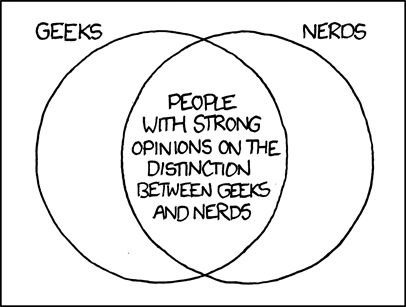
You can guess which category of the three I fall into. Here's another, more serious, Venn from the folks over at Laughing Squid:
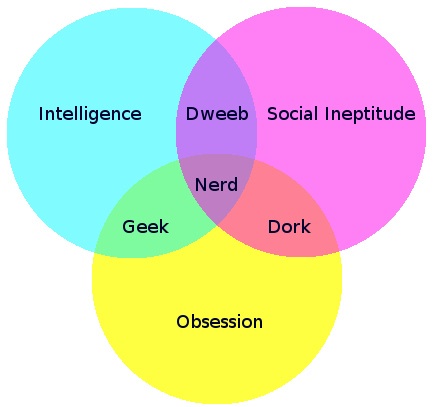
According to this system, my combination of intelligence and obsession makes me a geek rather than a nerd, which is the word I usually use to describe myself.
Knowing that self-diagnosis had failed me, I took my quest to the next level and found a test purporting to solve my identity crisis once and for all. I scored 91% nerd, 61% geek, and 39% dork, according to the test's definitions of the words, earning me the title of modern, cool nerd. (Spoiler alert: I have no idea what that means, since I don't think of myself as particularly modern or cool. The explanation below is merely my cut-and-paste attempt at sounding smart.)
"The Modern, Cool Nerd is intelligent, knowledgable and always the person to call in a crisis (needing computer advice/an arcane bit of trivia knowledge). They are the one you want as your lifeline in Who Wants to Be a Millionaire (or the one up there, winning the million bucks)! "
Great, I'll take it! My takeaway from all of this is less finding a particular word to describe myself than it is embracing an identity once thought of as an insult. I'm glad I live in a world where geek is chic and nerds can be modern and cool, or at least a world where I can be among fellow geeks and nerds. Remember, make fun of nerds at your own peril: you'll be working for us someday!
Last but not least, the all-important Venn of the Apocalypse:

I can't decide whether I'm pleased or concerned by the fact that my preferences place me squarely into the "death to humans" category.
Until next time,
Anna
Sunday, January 18, 2015
Sunday, January 11, 2015
Happy Blogiversary!
Greetings, fellow readers! This January marks our Blogiversary--Shelf Life has been going strong for two years now! I think this is the longest I've ever stuck with a new year's resolution, and I could never have anticipated the publication this blog has grown into. To continue with this positive trend, I'd like to announce a new resolution for the blog. Many of you have given me positive feedback concerning the videos I posted last fall; therefore, I'd like to resolve to make at least one of my monthly posts a video chronicle. This will keep me growing and learning as a blogger and hopefully provide some entertainment and variety for all of you.
With that being said, let's turn our attention to another significant event of the past week: the start of the spring semester! This semester might just be my favorite class lineup ever. I'm taking:
Latin I, with a professor who just might be the 11th Doctor in disguise (for all you Doctor Who fans out there). In addition to conjugating verbs and making fun of the ridiculous pronunciation guide, I'm keeping a Tie of the Day dossier to document his manifold bow tie choices.
Women Writers and Classical Mythology. This is easily shaping up to be my favorite class of the semester. It's taught by two of my favorite professors, one from the English department and one from Classics. We're reading modern poetry in conjunction with ancient myths and studying the connection between the two, particularly as it concerns the role of women in art and society. In addition to that, the class is curating an exhibit at the Harn Museum of Art and creating our own interpretation of women, myth, and visual culture via Pinterest--stay tuned for more on that once the project's underway.
American Literature Seminar: Sexing the Past. Described by my prof as "graduate school lite," this class is essentially the same as the UF graduate class with the same name, only with about half the reading and writing load. My AmLit teacher from last semester is leading this class, which promises to be an interesting investigation of what we talk about when we talk about sex, and how we can understand and study sex and sexuality when our own understanding of the two is both similar and different to the way we understood sex in the past. This week, we read part of Foucault's History of Sexuality and an excerpt from William Bradford's Of Plymouth Plantation called "A Terrible Case of Bestiality" for an early American take on sexual deviance.
Talk Nerdy to Me. This is a one-credit class I'm taking for fun with my roommate Allison and Shakespeare buddy David. It's about nerds and nerd culture, and while we haven't gotten too far into it, I'm stoked for our next meeting, which is listed on the syllabus as "I came in like a Pokeball." How can that class possibly be boring?
My last class, The Grandeur that was Rome, doesn't meet until tomorrow, so I have nothing to say about it except that the reading list looks promising. My prof from Classics and Fantasy is teaching it, which means we're sure to have good discussion.
That's all for now, except to say that my A Song of Ice and Fire readthrough has progressed to A Storm of Swords--ah, how I sigh to think of the carnage to come!
Until next time,
Anna
With that being said, let's turn our attention to another significant event of the past week: the start of the spring semester! This semester might just be my favorite class lineup ever. I'm taking:
Latin I, with a professor who just might be the 11th Doctor in disguise (for all you Doctor Who fans out there). In addition to conjugating verbs and making fun of the ridiculous pronunciation guide, I'm keeping a Tie of the Day dossier to document his manifold bow tie choices.
Women Writers and Classical Mythology. This is easily shaping up to be my favorite class of the semester. It's taught by two of my favorite professors, one from the English department and one from Classics. We're reading modern poetry in conjunction with ancient myths and studying the connection between the two, particularly as it concerns the role of women in art and society. In addition to that, the class is curating an exhibit at the Harn Museum of Art and creating our own interpretation of women, myth, and visual culture via Pinterest--stay tuned for more on that once the project's underway.
American Literature Seminar: Sexing the Past. Described by my prof as "graduate school lite," this class is essentially the same as the UF graduate class with the same name, only with about half the reading and writing load. My AmLit teacher from last semester is leading this class, which promises to be an interesting investigation of what we talk about when we talk about sex, and how we can understand and study sex and sexuality when our own understanding of the two is both similar and different to the way we understood sex in the past. This week, we read part of Foucault's History of Sexuality and an excerpt from William Bradford's Of Plymouth Plantation called "A Terrible Case of Bestiality" for an early American take on sexual deviance.
Talk Nerdy to Me. This is a one-credit class I'm taking for fun with my roommate Allison and Shakespeare buddy David. It's about nerds and nerd culture, and while we haven't gotten too far into it, I'm stoked for our next meeting, which is listed on the syllabus as "I came in like a Pokeball." How can that class possibly be boring?
My last class, The Grandeur that was Rome, doesn't meet until tomorrow, so I have nothing to say about it except that the reading list looks promising. My prof from Classics and Fantasy is teaching it, which means we're sure to have good discussion.
That's all for now, except to say that my A Song of Ice and Fire readthrough has progressed to A Storm of Swords--ah, how I sigh to think of the carnage to come!
Until next time,
Anna
Tuesday, December 30, 2014
Reading Recap: Books to Movies
Greetings, fellow readers! I hope that all of you celebrating enjoyed your many holidays and that you all make the most of the last days of 2014. This break, I haven't had much chance to read since I've been back to working full time at the bookstore, but I have made some progress in my A Song of Ice and Fire reread: I finished Game of Thrones and am about a third of the way through Clash of Kings.
Those of you who have been with me for some time know that I adore books which reward re-reading, and Martin's series does not disappoint. I have been reading in conjunction with watching the HBO series from start to finish (it's my second time for both the books and the show), and I'm amazed by how many details I had forgotten or missed, as well as how much more fun it is to read the books after having completed the Hedge Knight novellas and The World of Ice and Fire. This is a story world I dearly love to inhabit.
I'm also continuously impressed by all the work that went into adapting the books for film, which brings me to the theme of my post: books to movies. This Christmas, while I haven't read many new books, I have re-read old favorites in preparation for viewing their film adaptations, starting with . . .
The Hobbit by J.R.R. Tolkien. I was never a fan of this book--the Lord of the Rings series is much better both in terms of story and quality of writing--but since I was going to the theater to see The Battle of the Five Armies with my family, I thought it best to do a quick re-read. This was the first time my eleven-year-old sister had been introduced to anything related to LOTR, and it was a joy to watch how excited she was by the story, gasping, laughing, and crying at all the right moments. She was so curious to know what happened after the events which take place in The Hobbit, but luckily, she has a big sister willing to lend her books, DVDs, and nerdy good times. I'm very much looking forward to introducing her to a world where I spent my formative reading years.
As for the film, I thought the first and third in the trilogy did a decent job of combining elements of the novel with material from The Silmarilion and the original trilogy. I wasn't a fan of how drawn out the plot was; in many ways it seemed like the story was ancillary to the special effects, and I think it should be the other way around. Still, as a fan of all things Tolkien, I enjoyed the movie for what it was.
Next up is Farenheit 451 by Ray Bradbury. One of my dear friends, a retired Navy captain who taught me everything I know about book collecting, gave me my own copy of the book as well as the 1992 film on VHS for Christmas. I read the book on my own in high school, and I've never seen the movie, so I'm looking forward to revisiting an old favorite this Christmas. More thoughts on that to come in the future.
Until next time,
Anna
Those of you who have been with me for some time know that I adore books which reward re-reading, and Martin's series does not disappoint. I have been reading in conjunction with watching the HBO series from start to finish (it's my second time for both the books and the show), and I'm amazed by how many details I had forgotten or missed, as well as how much more fun it is to read the books after having completed the Hedge Knight novellas and The World of Ice and Fire. This is a story world I dearly love to inhabit.
I'm also continuously impressed by all the work that went into adapting the books for film, which brings me to the theme of my post: books to movies. This Christmas, while I haven't read many new books, I have re-read old favorites in preparation for viewing their film adaptations, starting with . . .
The Hobbit by J.R.R. Tolkien. I was never a fan of this book--the Lord of the Rings series is much better both in terms of story and quality of writing--but since I was going to the theater to see The Battle of the Five Armies with my family, I thought it best to do a quick re-read. This was the first time my eleven-year-old sister had been introduced to anything related to LOTR, and it was a joy to watch how excited she was by the story, gasping, laughing, and crying at all the right moments. She was so curious to know what happened after the events which take place in The Hobbit, but luckily, she has a big sister willing to lend her books, DVDs, and nerdy good times. I'm very much looking forward to introducing her to a world where I spent my formative reading years.
As for the film, I thought the first and third in the trilogy did a decent job of combining elements of the novel with material from The Silmarilion and the original trilogy. I wasn't a fan of how drawn out the plot was; in many ways it seemed like the story was ancillary to the special effects, and I think it should be the other way around. Still, as a fan of all things Tolkien, I enjoyed the movie for what it was.
Next up is Farenheit 451 by Ray Bradbury. One of my dear friends, a retired Navy captain who taught me everything I know about book collecting, gave me my own copy of the book as well as the 1992 film on VHS for Christmas. I read the book on my own in high school, and I've never seen the movie, so I'm looking forward to revisiting an old favorite this Christmas. More thoughts on that to come in the future.
Until next time,
Anna
Monday, December 15, 2014
Reading Recap: School Edition
Greetings, fellow readers! In the spirit of celebrating finals (see previous post), I now bring you my semester Reading Recap: School Edition.
For the last few weeks of the semester, I didn't have much reading to do, surprisingly enough. In my American Lit class, I finished Herman Melville's The Confidence Man, which I loved. According to my professor, it's "half as long as Moby Dick but twice as hard." I definitely see where she's coming from with that, but still, I am not deterred from the rest of the Melville corpus--it takes more than a big book to scare me away! I'm excited to be working more with Melville in my seminar next semester.
We also read Running a Thousand Miles for Freedom by William and Ellen Craft and a really strange novel called A Florida Enchantment, which was the bestselling popular novel of its day (think of it as the Gone Girl of 1892). Both of these were shorter works that deal with more of the fringe aspects of the Confidence Man trope: one being the nonfictional narrative of two escaped slaves, the other a story of magical seeds which cause sex change in those who eat them. These were not my favorite books in this class, mostly because the writing is not very good, but they are important because of what they tell us about the types of stories that get included in the canon of the Confidence Man.
We spent most of the last month in my Shakespeare seminar working on King Lear, which is so beautiful and depressing it makes me want to weep my eyes out every time I read it. So much of it is hard to stomach, but after reading it, I can no longer call Gonoreil and Reagan the "bad daughters." Lear is the true villain of the play, lusting after Cordelia, tyrannizing others with his monopoly on language, alienating his friends with cruelty. In many ways, Gonoreil and Reagan were just giving as good as they got, and poor Cordelia was just trying to survive.
With this pretty dim view of the nuclear family fresh in my mind, I transitioned to The Tempest, a play with a *slightly* less terrible father at its head. This is one of my favorite plays, not least because it's one I've performed in. It has some of Shakespeare's best pieces of poetry, and the whole thing is an homage to language itself (I'm one of those people who loves meta-everything and self-reflexive texts.) Reading the play took me back to our performance of it last year and my many fond memories of the cast, which was a great way to end a tough semester.
That's all I have for school reading; now that break has begun, you can expect many more reviews of pleasure books--huzzah!
Until next time,
Anna
For the last few weeks of the semester, I didn't have much reading to do, surprisingly enough. In my American Lit class, I finished Herman Melville's The Confidence Man, which I loved. According to my professor, it's "half as long as Moby Dick but twice as hard." I definitely see where she's coming from with that, but still, I am not deterred from the rest of the Melville corpus--it takes more than a big book to scare me away! I'm excited to be working more with Melville in my seminar next semester.
We also read Running a Thousand Miles for Freedom by William and Ellen Craft and a really strange novel called A Florida Enchantment, which was the bestselling popular novel of its day (think of it as the Gone Girl of 1892). Both of these were shorter works that deal with more of the fringe aspects of the Confidence Man trope: one being the nonfictional narrative of two escaped slaves, the other a story of magical seeds which cause sex change in those who eat them. These were not my favorite books in this class, mostly because the writing is not very good, but they are important because of what they tell us about the types of stories that get included in the canon of the Confidence Man.
We spent most of the last month in my Shakespeare seminar working on King Lear, which is so beautiful and depressing it makes me want to weep my eyes out every time I read it. So much of it is hard to stomach, but after reading it, I can no longer call Gonoreil and Reagan the "bad daughters." Lear is the true villain of the play, lusting after Cordelia, tyrannizing others with his monopoly on language, alienating his friends with cruelty. In many ways, Gonoreil and Reagan were just giving as good as they got, and poor Cordelia was just trying to survive.
With this pretty dim view of the nuclear family fresh in my mind, I transitioned to The Tempest, a play with a *slightly* less terrible father at its head. This is one of my favorite plays, not least because it's one I've performed in. It has some of Shakespeare's best pieces of poetry, and the whole thing is an homage to language itself (I'm one of those people who loves meta-everything and self-reflexive texts.) Reading the play took me back to our performance of it last year and my many fond memories of the cast, which was a great way to end a tough semester.
That's all I have for school reading; now that break has begun, you can expect many more reviews of pleasure books--huzzah!
Until next time,
Anna
"The Book of Lost Things" Review
Greetings, fellow readers! Now that finals are over, I'd like to celebrate by sharing a review with you. In the last couple weeks of school, I had very little homework/assigned reading, so I read The Book of Lost Things by John Connolly. I got this book from work over the summer but only just got around to reading it now . . . I know, my TBR really is too long. I really enjoyed this book: it's about a young boy named David who loves to read fairy tales and escapes from his home in World War II-era London into the pages of his favorite books.
Connolly does a decent job of synthesizing elements of many different fairy tales and other works of literature (including one of my favorite poems, "Childe Roland to the Dark Tower Came") into a novel-length work, and his extensive footnotes on the source material made my little academic heart very happy indeed. As a fan of fairy tale retellings, I enjoyed his adherence to the darkness and violence of the original Grimm tales. My one criticism of this book is that the ending was too neat and tidy: for a book which does not shy away from the gruesome, I thought the ending was contrived. Still, I would recommend this to readers looking for a good yarn to while away the long winter nights.
I'm looking forward to seeing what else this author has written.
Until next time,
Anna
Connolly does a decent job of synthesizing elements of many different fairy tales and other works of literature (including one of my favorite poems, "Childe Roland to the Dark Tower Came") into a novel-length work, and his extensive footnotes on the source material made my little academic heart very happy indeed. As a fan of fairy tale retellings, I enjoyed his adherence to the darkness and violence of the original Grimm tales. My one criticism of this book is that the ending was too neat and tidy: for a book which does not shy away from the gruesome, I thought the ending was contrived. Still, I would recommend this to readers looking for a good yarn to while away the long winter nights.
I'm looking forward to seeing what else this author has written.
Until next time,
Anna
Subscribe to:
Posts (Atom)