Greetings, fellow readers! This semester has been exceptionally stressful and difficult for me because of grad school applications and general anxiety about the future, so I hope you will forgive me for not being as diligent in my posting as usual. As my penultimate semester of undergrad draws to a close, I've been thinking a lot about one of my favorite lines from Hamlet--funny, I know, how I always seem to come back to this particular play. The quote comes from Ophelia's mad scene, when she addresses the members of the court with striking directness. She says, "We know what we are, not what we may become."
This semester has been a struggle to live in the absolute present: I have very few concrete directions in which my life will go after graduation. Most notably, I won't know which, if any, grad schools I'm accepted to until March. All I know is who I am and what I have made of my life these past four years at UF. I'd like to think that when graduation comes (in four short months, wow!) I'll have left something meaningful behind.
I'm super uncertain about a lot of things, but whenever I feel my jitters about the future starting to stress me out, I try to think of what Ophelia says. I could never have anticipated what I would become during my time at UF, and no matter where I end up after, I have similar expectations that I will do extraordinary things.
That, dear readers, is my state of mind at the end of the year. I hope all your finals/end of year reports/work-related activities are going well, and I wish you all a healthy and happy holiday season.
Until next time,
Anna
Thursday, December 17, 2015

Tuesday, April 28, 2015
End of Semester Reading Roundup
Greetings, fellow readers! Freedom from academic reading is nigh, and with the summer comes my return to my job at the bookstore, where I can borrow any book I want from work for free--such bliss! I have several titles I cannot wait to read, including:
Station Eleven by Emily St. John Mandel, which I have dipped into on and off over the past two weeks or so. It's about a group of post-apocalyptic traveling Shakespeare actors, so of course, it's right up my alley. I'm not very far into it, but I find the characters' arguments about whether to perform comedies or tragedies when everyone's dropping dead from the superflu particularly prescient. So much of the discourse in English and humanities circles right now centers on the utility of these disciplines in a world where concrete production is often prized over abstract reasoning. The traveling players are literally enacting the current Great Struggle of my field right now, and I'm excited to see where they go with it. Of course, I'm also looking forward to picking apart all the Shakespeare references.
The Invasion of the Tearling by Erika Johansen. This is the much-anticipated sequel to The Queen of the Tearling, a fantasy novel which I discovered at work last summer and loved. This is one of those books which cries out to be made into a series, and when the new installment comes, it'll be like Christmas in July.
City of Thieves by David Benioff. I found this book randomly on Goodreads (yes, I redownloaded the app, after much internal conflict), and it seems like the perfect way to continue my Russian literature kick. By the way, if any of you have good Russian lit recommendations, do let me know. It's mostly new terrain for me, aside from obvious titles like Anna Karenina, etc.
Also, if you want to follow me on Goodreads and share your recs that way, you can do so here.
The Complete Tales by Edgar Allan Poe. This one is slightly work-related, since it's very likely I'll be writing my senior thesis on Poe this spring. Still, I've been a fan of his stories ever since "The Tell-Tale Heart" scared the bejeezus out of me at the ripe old age of eight. It's going to be fun to go back and reread some old favorites, as well as discover new ones, and if I get any good thesis ideas, well, you won't hear any complaints!
This last one isn't really a reading book per se, but The Essential New York Times Cookbook edited by the incomparable Amanda Hesser has recently joined the literary tomes on my shelves. I picked it up for $5 at the Friends of the Library booksale this weekend, and it's chock full of so many good things to cook, I don't know where to start! I'm moving out of the dorms and into an apartment this year, so I'll finally be able to do some real cooking, and summer is the perfect time to practice.
Until next time,
Anna
Station Eleven by Emily St. John Mandel, which I have dipped into on and off over the past two weeks or so. It's about a group of post-apocalyptic traveling Shakespeare actors, so of course, it's right up my alley. I'm not very far into it, but I find the characters' arguments about whether to perform comedies or tragedies when everyone's dropping dead from the superflu particularly prescient. So much of the discourse in English and humanities circles right now centers on the utility of these disciplines in a world where concrete production is often prized over abstract reasoning. The traveling players are literally enacting the current Great Struggle of my field right now, and I'm excited to see where they go with it. Of course, I'm also looking forward to picking apart all the Shakespeare references.
The Invasion of the Tearling by Erika Johansen. This is the much-anticipated sequel to The Queen of the Tearling, a fantasy novel which I discovered at work last summer and loved. This is one of those books which cries out to be made into a series, and when the new installment comes, it'll be like Christmas in July.
City of Thieves by David Benioff. I found this book randomly on Goodreads (yes, I redownloaded the app, after much internal conflict), and it seems like the perfect way to continue my Russian literature kick. By the way, if any of you have good Russian lit recommendations, do let me know. It's mostly new terrain for me, aside from obvious titles like Anna Karenina, etc.
Also, if you want to follow me on Goodreads and share your recs that way, you can do so here.
The Complete Tales by Edgar Allan Poe. This one is slightly work-related, since it's very likely I'll be writing my senior thesis on Poe this spring. Still, I've been a fan of his stories ever since "The Tell-Tale Heart" scared the bejeezus out of me at the ripe old age of eight. It's going to be fun to go back and reread some old favorites, as well as discover new ones, and if I get any good thesis ideas, well, you won't hear any complaints!
This last one isn't really a reading book per se, but The Essential New York Times Cookbook edited by the incomparable Amanda Hesser has recently joined the literary tomes on my shelves. I picked it up for $5 at the Friends of the Library booksale this weekend, and it's chock full of so many good things to cook, I don't know where to start! I'm moving out of the dorms and into an apartment this year, so I'll finally be able to do some real cooking, and summer is the perfect time to practice.
Until next time,
Anna
Monday, April 20, 2015

Tuesday, April 14, 2015
Pure Imagination: A New Look at Seneca's "Thyestes"
Greetings, fellow readers! This week in my Latin literature class, we've been reading a play by Seneca called "Thyestes." It's a story about two brothers, Atreus and Thyestes, who both desire the same throne. Atreus also wants to get revenge on Thyestes because Thyestes had an affair with Atreus's wife, so he devises a plan to enact the worst possible vengeance: he invites his brother to a banquet where the main dish is the cooked bodies of Thyestes's own sons.
Pretty messed up, right? In the original myth, this is only one gruesome episode of many caused by an old family curse: you may know of Tantalus, one of the more famous members of the house of Atreus, who was condemned to eternal hunger and thirst in the underworld, all while delicious fruit and water lay within his sight, but not his reach. (Fun fact: he's also where we get our word tantalize from.)
What really interested me is the fact that Seneca was writing this during the reign of Nero, the infamous emperor who supposedly fiddled while Rome burned. (As it turns out, that's probably an anachronism, but we won't get into that now.) Seneca himself was Nero's childhood tutor, and later lived through some of the worst atrocities of Nero's reign before his exile and eventual suicide.
Seneca was also known for being a Stoic philosopher, or one who accepts what happens to them as the inexorable will of the gods. Stoics were known for their impassive, emotionless attitude towards misfortune, their praise of intellectual virtue, and their belief in retreat from society to lead a life of the mind.
So why does Seneca, the sage old Stoic, write a play about the will to power and this toxic family feud? Perhaps it's because of what he saw around him every day: the ruling family of imperial Rome at the time was not exactly known for being mentally sound, nor were the majority of them good leaders. Nero himself bankrupted the state to fund public entertainments and theatrics, and he took advantage of those who lost their homes in the Great Fire by claiming their land to build his palatial Golden House.
"Thyestes" raises a lot of questions about what constitutes the right to rule, and whether any one person can truly claim such a right, especially if the ruler is not mentally sound. We've been talking a lot in this class about whether the Roman emperors became corrupt because they were bad to begin with, or whether their unmitigated power had a degenerative effect on their sense of right and wrong. In the historical cases, I'm inclined to say it was a combination of both, and so it is in "Thyestes."
There is something fundamentally rotten at the heart of this story, and Atreus himself knows it. As he explains his murderous plans to his servant in the opening scenes, he declares "Evil is not avenged, it is outdone." Likewise, he refers to the banquet he will serve his brother as so monstrous it will dampen even Tantalus's insatiable appetite.
In addition to reading the play, we also watched excerpts from various stage adaptations. My favorite was the Barnard/Columbia student production, which set the play in a Wonka-esque space tinged with elements of a horror movie. In this production, both Atreus and Thyestes look like grotesque carnival clowns, Thyestes's children are nothing more than wooden puppets, and the entire set looks eerily like the scribbles of a deranged four-year-old. Spooky music from the "Wonka" movie soundtrack echoes throughout, signifying to the audience that a world of pure imagination might not be as delightful as it sounds.
While Atreus comes up with the evil plan, Thyestes still chooses to eat the children. All protestations about the Fates aside, I suspect this is what Seneca was trying to work through: the guilt of being not the evil mastermind of a plan, but of being a willing accomplice who never tried to stand up to Nero and his excesses. In the Barnard/Columbia adaptation, there is little to no difference between Atreus and Thyestes; likewise, there are no guiltless characters, except perhaps the children. However, the children are puppets, not people, which renders their innocence or guilt irrelevant.
The play mirrors the Wonka story because there is no clear hero or villian: Wonka and Slugworth (or Thyestes and Atreus) are two sides of the same manipulative coin, continuously proving that nothing is sacred, even--perhaps especially--within families.
Until next time,
Anna
Pretty messed up, right? In the original myth, this is only one gruesome episode of many caused by an old family curse: you may know of Tantalus, one of the more famous members of the house of Atreus, who was condemned to eternal hunger and thirst in the underworld, all while delicious fruit and water lay within his sight, but not his reach. (Fun fact: he's also where we get our word tantalize from.)
What really interested me is the fact that Seneca was writing this during the reign of Nero, the infamous emperor who supposedly fiddled while Rome burned. (As it turns out, that's probably an anachronism, but we won't get into that now.) Seneca himself was Nero's childhood tutor, and later lived through some of the worst atrocities of Nero's reign before his exile and eventual suicide.
Seneca was also known for being a Stoic philosopher, or one who accepts what happens to them as the inexorable will of the gods. Stoics were known for their impassive, emotionless attitude towards misfortune, their praise of intellectual virtue, and their belief in retreat from society to lead a life of the mind.
So why does Seneca, the sage old Stoic, write a play about the will to power and this toxic family feud? Perhaps it's because of what he saw around him every day: the ruling family of imperial Rome at the time was not exactly known for being mentally sound, nor were the majority of them good leaders. Nero himself bankrupted the state to fund public entertainments and theatrics, and he took advantage of those who lost their homes in the Great Fire by claiming their land to build his palatial Golden House.
"Thyestes" raises a lot of questions about what constitutes the right to rule, and whether any one person can truly claim such a right, especially if the ruler is not mentally sound. We've been talking a lot in this class about whether the Roman emperors became corrupt because they were bad to begin with, or whether their unmitigated power had a degenerative effect on their sense of right and wrong. In the historical cases, I'm inclined to say it was a combination of both, and so it is in "Thyestes."
There is something fundamentally rotten at the heart of this story, and Atreus himself knows it. As he explains his murderous plans to his servant in the opening scenes, he declares "Evil is not avenged, it is outdone." Likewise, he refers to the banquet he will serve his brother as so monstrous it will dampen even Tantalus's insatiable appetite.
In addition to reading the play, we also watched excerpts from various stage adaptations. My favorite was the Barnard/Columbia student production, which set the play in a Wonka-esque space tinged with elements of a horror movie. In this production, both Atreus and Thyestes look like grotesque carnival clowns, Thyestes's children are nothing more than wooden puppets, and the entire set looks eerily like the scribbles of a deranged four-year-old. Spooky music from the "Wonka" movie soundtrack echoes throughout, signifying to the audience that a world of pure imagination might not be as delightful as it sounds.
While Atreus comes up with the evil plan, Thyestes still chooses to eat the children. All protestations about the Fates aside, I suspect this is what Seneca was trying to work through: the guilt of being not the evil mastermind of a plan, but of being a willing accomplice who never tried to stand up to Nero and his excesses. In the Barnard/Columbia adaptation, there is little to no difference between Atreus and Thyestes; likewise, there are no guiltless characters, except perhaps the children. However, the children are puppets, not people, which renders their innocence or guilt irrelevant.
The play mirrors the Wonka story because there is no clear hero or villian: Wonka and Slugworth (or Thyestes and Atreus) are two sides of the same manipulative coin, continuously proving that nothing is sacred, even--perhaps especially--within families.
Until next time,
Anna
Saturday, March 28, 2015
So it's been a while . . .
Greetings, fellow readers! It has been too long since I've given you an update; thank you for your patience. Final paper season is upon us, and I've been buried in a morass of summaries, research proposals, and draft revisions, as well as one bizarre fact-gathering mission at the library that, I swear, could have been lifted out of a Kafka short story.
I haven't had much time for pleasure reading, but I'm hoping to change that with the onset of the summer and the return of my daily lunch breaks from working at the bookstore. I have been reading one book my friend Elli gave me last year. It's called The Book of Ruth, and it's a novel about a girl growing up in rural Illinois during the Vietnam War. If you're a fan of unreliable narrators, this is the book for you! The writing is plain and Midwestern, reminiscent of the novels of Willa Cather or Ernest Hemingway. If this book were a landscape, it would be a wide open prairie, dotted with a few solitary trees here and there, beautiful in all its loneliness.
I've been doing much more reading for class, including the research for my final paper for the American Lit seminar. I'm planning on writing on Edgar Allan Poe's second detective fiction, "The Mystery of Marie Roget." In it, Detective Dupin proposes to solve the mystery of a young girl's disappearance and death before the police do, using the newspapers as his only source of information.
This story is really weird and difficult to read, leading some critics to write it off as a failure. What I'm arguing is that Poe's story, which was based on historical events, actually has more to tell us about the problems of interpretation and the dangers of making assumptions about people based on their gender than a simple whodunit. This tale doesn't follow the typical narrative strategy of the murder mystery, but that turns out to be an asset, rather than a weakness. I've just submitted a short analysis paper, which I'm hoping to turn into a longer project, so I'll be keeping you posted with how that goes.
I wish I had more to give you, but it seems we must wait until the dust settles and I can read more books.
Until next time,
Anna
I haven't had much time for pleasure reading, but I'm hoping to change that with the onset of the summer and the return of my daily lunch breaks from working at the bookstore. I have been reading one book my friend Elli gave me last year. It's called The Book of Ruth, and it's a novel about a girl growing up in rural Illinois during the Vietnam War. If you're a fan of unreliable narrators, this is the book for you! The writing is plain and Midwestern, reminiscent of the novels of Willa Cather or Ernest Hemingway. If this book were a landscape, it would be a wide open prairie, dotted with a few solitary trees here and there, beautiful in all its loneliness.
I've been doing much more reading for class, including the research for my final paper for the American Lit seminar. I'm planning on writing on Edgar Allan Poe's second detective fiction, "The Mystery of Marie Roget." In it, Detective Dupin proposes to solve the mystery of a young girl's disappearance and death before the police do, using the newspapers as his only source of information.
This story is really weird and difficult to read, leading some critics to write it off as a failure. What I'm arguing is that Poe's story, which was based on historical events, actually has more to tell us about the problems of interpretation and the dangers of making assumptions about people based on their gender than a simple whodunit. This tale doesn't follow the typical narrative strategy of the murder mystery, but that turns out to be an asset, rather than a weakness. I've just submitted a short analysis paper, which I'm hoping to turn into a longer project, so I'll be keeping you posted with how that goes.
I wish I had more to give you, but it seems we must wait until the dust settles and I can read more books.
Until next time,
Anna
Saturday, February 28, 2015
Reading Recap: Midterm
Greetings, fellow readers! My sincerest apologies for neglecting you all for nearly a month--I will try to remedy my absenteeism with an especially thought-provoking post today.
We've now reached the midpoint in the semester: everyone's heading home for spring break, and I, for one, cannot wait to curl up on the couch with a blanket and a giant stack of books and a never ending supply of tea. Some titles I'm particularly looking forward to are:
Cloud Atlas by David Mitchell, which I started reading last weekend, knowing full well I would want some uninterrupted spurts of free time to truly enjoy this novel. I'm only about 100 pages in, so take this with a grain of salt, but I really like the novel's structure: its chapters are arranged like Russian nesting dolls or atomic orbitals, each embedded within another, bigger shell, yet all connected as part of an organic whole. I like some of the styles and voices better than others (Adam Ewing's delightfully verbose diary, for example), and while I'm still not entirely sure where the story is going, I have high hopes that I'll enjoy the ride.
Another book I have queued up is The Swerve: How the World Became Modern by Shakespeare scholar Stephen Greenblatt. This one is of particular interest to me because it details the rediscovery of Lucretius's De Rerum Natura in manuscript form by an Italian monk during the Renaissance. I had to read Lucretius's book, which is a philosophical discussion of atomic theory and the question of free will, for my Latin Literature class this semester. Also, my Shakespeare professor last semester was constantly citing instances of Lucretius's influence on Shakespeare, which is part of what Greenblatt discusses in his book.
These next few books I haven't started yet, so I'll just stick to my reasons for reading them.
Smoke Gets in Your Eyes: And Other Lessons from the Crematory by Caitlin Doughty is one I found at the public library. It caught my eye because of the author's unique perspective within the memoir genre.
The Lagoon: How Aristotle Invented Modern Science by Armand Marie Leroi is another public library find. It's pretty long, hence I saved it for spring break.
Texts from Jane Eyre: And Other Conversations with your Favorite Literary Characters by Mallory Ortberg looks to be a fun treat in the tradition of Ophelia Joined the Group Maidens Who Don't Float: Classic Lit Signs on to Facebook. Not a novel, but seems enjoyable.
Love Cake by Leah Piepzna-Samarasinha. This book of modern poetry is one my friend Sally gave me for my birthday. The author is a queer feminist poet who takes on topics as diverse as terrorism, romance, sexual abuse, and our definitions of beauty. Sally's review made this book sound amazing, and I can't wait to read it.
Until next time,
Anna
We've now reached the midpoint in the semester: everyone's heading home for spring break, and I, for one, cannot wait to curl up on the couch with a blanket and a giant stack of books and a never ending supply of tea. Some titles I'm particularly looking forward to are:
Cloud Atlas by David Mitchell, which I started reading last weekend, knowing full well I would want some uninterrupted spurts of free time to truly enjoy this novel. I'm only about 100 pages in, so take this with a grain of salt, but I really like the novel's structure: its chapters are arranged like Russian nesting dolls or atomic orbitals, each embedded within another, bigger shell, yet all connected as part of an organic whole. I like some of the styles and voices better than others (Adam Ewing's delightfully verbose diary, for example), and while I'm still not entirely sure where the story is going, I have high hopes that I'll enjoy the ride.
Another book I have queued up is The Swerve: How the World Became Modern by Shakespeare scholar Stephen Greenblatt. This one is of particular interest to me because it details the rediscovery of Lucretius's De Rerum Natura in manuscript form by an Italian monk during the Renaissance. I had to read Lucretius's book, which is a philosophical discussion of atomic theory and the question of free will, for my Latin Literature class this semester. Also, my Shakespeare professor last semester was constantly citing instances of Lucretius's influence on Shakespeare, which is part of what Greenblatt discusses in his book.
These next few books I haven't started yet, so I'll just stick to my reasons for reading them.
Smoke Gets in Your Eyes: And Other Lessons from the Crematory by Caitlin Doughty is one I found at the public library. It caught my eye because of the author's unique perspective within the memoir genre.
The Lagoon: How Aristotle Invented Modern Science by Armand Marie Leroi is another public library find. It's pretty long, hence I saved it for spring break.
Texts from Jane Eyre: And Other Conversations with your Favorite Literary Characters by Mallory Ortberg looks to be a fun treat in the tradition of Ophelia Joined the Group Maidens Who Don't Float: Classic Lit Signs on to Facebook. Not a novel, but seems enjoyable.
Love Cake by Leah Piepzna-Samarasinha. This book of modern poetry is one my friend Sally gave me for my birthday. The author is a queer feminist poet who takes on topics as diverse as terrorism, romance, sexual abuse, and our definitions of beauty. Sally's review made this book sound amazing, and I can't wait to read it.
Until next time,
Anna
Sunday, February 1, 2015
Let's Talk Timelines
Greetings, fellow readers! So last week, I went a little Venn Diagram crazy on you, and I thought I'd make it up to you by keeping this post a little more . . . linear, shall we say. I made a timeline of the important moments in my life for a class project; it's not a blog post per se, but it should keep you busy while I get some more reading done. Enjoy!
Until next time,
Anna
Until next time,
Anna
Tuesday, January 20, 2015
Nerd, Geek, Dork
Greetings, fellow readers! Many of you have approached me with questions about the video I posted earlier this week: why did you make this video? How come you and your roommate have such good chemistry on screen? Where can I get Shakespeare socks like yours? Can I have your autograph?
Ok, that last one isn't true, but I will do my best to assuage your curiosity on the previous counts. As I have mentioned before, my roommate Allison is one of my best friends and a person I consider a member of my family. She and I were randomly assigned roommates in the Honors dorm at UF our freshman year, and we've been living together, thick as thieves ever since then (going on three years, woo hoo!)
The Shakespeare socks are from the internet (where else?) and of course, you may have my autograph, preferably on the frontispiece of my Pulitzer Prize-winning novel, release date TBD.
But Anna, I can hear you asking, what about the most important question, the one which holds the key to all the mysteries of life: why did you make this video in the first place? Patience, young padawans. You will learn when you are ready.
As I have mentioned before, I am taking a one credit (fun credit, really) class called Talk Nerdy to Me, and our first project was to make a vlog about when we became a nerd. Blessed with both beauty and talent, not to mention excellent chemistry, Allison and I decided to make this video together, little knowing what a hit it would be.
Fast forward a bit and you'll find me today in the midst of a conversation with my friend Sean about what it means to be a nerd, specifically as distinct from being a geek or a dork.
Like any word nerd worth her salt, I decided to begin by looking it up in the Oxford English Dictionary, which defines a nerd as "An insignificant or contemptible person, one who is conventional, affected, or studious; a 'square,' a 'swot.'" The first recorded incidence of the word "nerd" was in the 1950 picture book If I Ran the Zoo by Dr. Seuss, who wrote, "And then, just to show them, I'll sail to Ka-Troo And Bring Back an It-Kutch, a Preep and a Proo, a Nerkle, a Nerd, and a Seersucker, too!"
Despite this delightful lilting lyric, I do not think of myself as either insignificant or contemptible, so I moved on to the word "geek," which predates "nerd" by at least fifty years, appearing for the first time in the late nineteenth century. Alas, the dictionary informed me that a geek is "an unfashionable or socially inept person." "Dork" didn't give me too much luck either--it is defined as "a dull, slow-witted, or socially inept person" and derives from an American slang term for "penis" in the 1960's.
With pejoratives on the brain, I at last hearkened to that great fount of internet knowledge, the webcomic xkcd, whose author constructed a very helpful Venn diagram for those of us who care about our stance on these issues:


Ok, that last one isn't true, but I will do my best to assuage your curiosity on the previous counts. As I have mentioned before, my roommate Allison is one of my best friends and a person I consider a member of my family. She and I were randomly assigned roommates in the Honors dorm at UF our freshman year, and we've been living together, thick as thieves ever since then (going on three years, woo hoo!)
The Shakespeare socks are from the internet (where else?) and of course, you may have my autograph, preferably on the frontispiece of my Pulitzer Prize-winning novel, release date TBD.
But Anna, I can hear you asking, what about the most important question, the one which holds the key to all the mysteries of life: why did you make this video in the first place? Patience, young padawans. You will learn when you are ready.
As I have mentioned before, I am taking a one credit (fun credit, really) class called Talk Nerdy to Me, and our first project was to make a vlog about when we became a nerd. Blessed with both beauty and talent, not to mention excellent chemistry, Allison and I decided to make this video together, little knowing what a hit it would be.
Fast forward a bit and you'll find me today in the midst of a conversation with my friend Sean about what it means to be a nerd, specifically as distinct from being a geek or a dork.
Like any word nerd worth her salt, I decided to begin by looking it up in the Oxford English Dictionary, which defines a nerd as "An insignificant or contemptible person, one who is conventional, affected, or studious; a 'square,' a 'swot.'" The first recorded incidence of the word "nerd" was in the 1950 picture book If I Ran the Zoo by Dr. Seuss, who wrote, "And then, just to show them, I'll sail to Ka-Troo And Bring Back an It-Kutch, a Preep and a Proo, a Nerkle, a Nerd, and a Seersucker, too!"
Despite this delightful lilting lyric, I do not think of myself as either insignificant or contemptible, so I moved on to the word "geek," which predates "nerd" by at least fifty years, appearing for the first time in the late nineteenth century. Alas, the dictionary informed me that a geek is "an unfashionable or socially inept person." "Dork" didn't give me too much luck either--it is defined as "a dull, slow-witted, or socially inept person" and derives from an American slang term for "penis" in the 1960's.
With pejoratives on the brain, I at last hearkened to that great fount of internet knowledge, the webcomic xkcd, whose author constructed a very helpful Venn diagram for those of us who care about our stance on these issues:
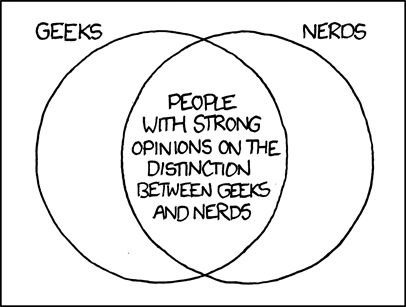
You can guess which category of the three I fall into. Here's another, more serious, Venn from the folks over at Laughing Squid:
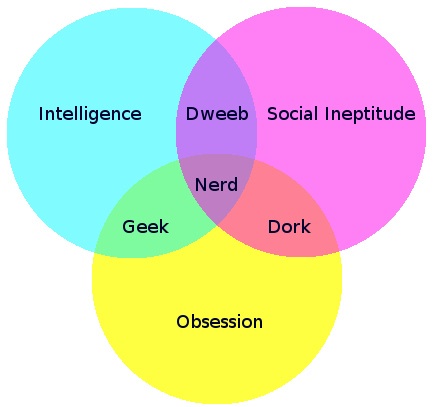
According to this system, my combination of intelligence and obsession makes me a geek rather than a nerd, which is the word I usually use to describe myself.
Knowing that self-diagnosis had failed me, I took my quest to the next level and found a test purporting to solve my identity crisis once and for all. I scored 91% nerd, 61% geek, and 39% dork, according to the test's definitions of the words, earning me the title of modern, cool nerd. (Spoiler alert: I have no idea what that means, since I don't think of myself as particularly modern or cool. The explanation below is merely my cut-and-paste attempt at sounding smart.)
"The Modern, Cool Nerd is intelligent, knowledgable and always the person to call in a crisis (needing computer advice/an arcane bit of trivia knowledge). They are the one you want as your lifeline in Who Wants to Be a Millionaire (or the one up there, winning the million bucks)! "
Great, I'll take it! My takeaway from all of this is less finding a particular word to describe myself than it is embracing an identity once thought of as an insult. I'm glad I live in a world where geek is chic and nerds can be modern and cool, or at least a world where I can be among fellow geeks and nerds. Remember, make fun of nerds at your own peril: you'll be working for us someday!
Last but not least, the all-important Venn of the Apocalypse:

I can't decide whether I'm pleased or concerned by the fact that my preferences place me squarely into the "death to humans" category.
Until next time,
Anna
Sunday, January 18, 2015
Sunday, January 11, 2015
Happy Blogiversary!
Greetings, fellow readers! This January marks our Blogiversary--Shelf Life has been going strong for two years now! I think this is the longest I've ever stuck with a new year's resolution, and I could never have anticipated the publication this blog has grown into. To continue with this positive trend, I'd like to announce a new resolution for the blog. Many of you have given me positive feedback concerning the videos I posted last fall; therefore, I'd like to resolve to make at least one of my monthly posts a video chronicle. This will keep me growing and learning as a blogger and hopefully provide some entertainment and variety for all of you.
With that being said, let's turn our attention to another significant event of the past week: the start of the spring semester! This semester might just be my favorite class lineup ever. I'm taking:
Latin I, with a professor who just might be the 11th Doctor in disguise (for all you Doctor Who fans out there). In addition to conjugating verbs and making fun of the ridiculous pronunciation guide, I'm keeping a Tie of the Day dossier to document his manifold bow tie choices.
Women Writers and Classical Mythology. This is easily shaping up to be my favorite class of the semester. It's taught by two of my favorite professors, one from the English department and one from Classics. We're reading modern poetry in conjunction with ancient myths and studying the connection between the two, particularly as it concerns the role of women in art and society. In addition to that, the class is curating an exhibit at the Harn Museum of Art and creating our own interpretation of women, myth, and visual culture via Pinterest--stay tuned for more on that once the project's underway.
American Literature Seminar: Sexing the Past. Described by my prof as "graduate school lite," this class is essentially the same as the UF graduate class with the same name, only with about half the reading and writing load. My AmLit teacher from last semester is leading this class, which promises to be an interesting investigation of what we talk about when we talk about sex, and how we can understand and study sex and sexuality when our own understanding of the two is both similar and different to the way we understood sex in the past. This week, we read part of Foucault's History of Sexuality and an excerpt from William Bradford's Of Plymouth Plantation called "A Terrible Case of Bestiality" for an early American take on sexual deviance.
Talk Nerdy to Me. This is a one-credit class I'm taking for fun with my roommate Allison and Shakespeare buddy David. It's about nerds and nerd culture, and while we haven't gotten too far into it, I'm stoked for our next meeting, which is listed on the syllabus as "I came in like a Pokeball." How can that class possibly be boring?
My last class, The Grandeur that was Rome, doesn't meet until tomorrow, so I have nothing to say about it except that the reading list looks promising. My prof from Classics and Fantasy is teaching it, which means we're sure to have good discussion.
That's all for now, except to say that my A Song of Ice and Fire readthrough has progressed to A Storm of Swords--ah, how I sigh to think of the carnage to come!
Until next time,
Anna
With that being said, let's turn our attention to another significant event of the past week: the start of the spring semester! This semester might just be my favorite class lineup ever. I'm taking:
Latin I, with a professor who just might be the 11th Doctor in disguise (for all you Doctor Who fans out there). In addition to conjugating verbs and making fun of the ridiculous pronunciation guide, I'm keeping a Tie of the Day dossier to document his manifold bow tie choices.
Women Writers and Classical Mythology. This is easily shaping up to be my favorite class of the semester. It's taught by two of my favorite professors, one from the English department and one from Classics. We're reading modern poetry in conjunction with ancient myths and studying the connection between the two, particularly as it concerns the role of women in art and society. In addition to that, the class is curating an exhibit at the Harn Museum of Art and creating our own interpretation of women, myth, and visual culture via Pinterest--stay tuned for more on that once the project's underway.
American Literature Seminar: Sexing the Past. Described by my prof as "graduate school lite," this class is essentially the same as the UF graduate class with the same name, only with about half the reading and writing load. My AmLit teacher from last semester is leading this class, which promises to be an interesting investigation of what we talk about when we talk about sex, and how we can understand and study sex and sexuality when our own understanding of the two is both similar and different to the way we understood sex in the past. This week, we read part of Foucault's History of Sexuality and an excerpt from William Bradford's Of Plymouth Plantation called "A Terrible Case of Bestiality" for an early American take on sexual deviance.
Talk Nerdy to Me. This is a one-credit class I'm taking for fun with my roommate Allison and Shakespeare buddy David. It's about nerds and nerd culture, and while we haven't gotten too far into it, I'm stoked for our next meeting, which is listed on the syllabus as "I came in like a Pokeball." How can that class possibly be boring?
My last class, The Grandeur that was Rome, doesn't meet until tomorrow, so I have nothing to say about it except that the reading list looks promising. My prof from Classics and Fantasy is teaching it, which means we're sure to have good discussion.
That's all for now, except to say that my A Song of Ice and Fire readthrough has progressed to A Storm of Swords--ah, how I sigh to think of the carnage to come!
Until next time,
Anna
Tuesday, December 30, 2014
Reading Recap: Books to Movies
Greetings, fellow readers! I hope that all of you celebrating enjoyed your many holidays and that you all make the most of the last days of 2014. This break, I haven't had much chance to read since I've been back to working full time at the bookstore, but I have made some progress in my A Song of Ice and Fire reread: I finished Game of Thrones and am about a third of the way through Clash of Kings.
Those of you who have been with me for some time know that I adore books which reward re-reading, and Martin's series does not disappoint. I have been reading in conjunction with watching the HBO series from start to finish (it's my second time for both the books and the show), and I'm amazed by how many details I had forgotten or missed, as well as how much more fun it is to read the books after having completed the Hedge Knight novellas and The World of Ice and Fire. This is a story world I dearly love to inhabit.
I'm also continuously impressed by all the work that went into adapting the books for film, which brings me to the theme of my post: books to movies. This Christmas, while I haven't read many new books, I have re-read old favorites in preparation for viewing their film adaptations, starting with . . .
The Hobbit by J.R.R. Tolkien. I was never a fan of this book--the Lord of the Rings series is much better both in terms of story and quality of writing--but since I was going to the theater to see The Battle of the Five Armies with my family, I thought it best to do a quick re-read. This was the first time my eleven-year-old sister had been introduced to anything related to LOTR, and it was a joy to watch how excited she was by the story, gasping, laughing, and crying at all the right moments. She was so curious to know what happened after the events which take place in The Hobbit, but luckily, she has a big sister willing to lend her books, DVDs, and nerdy good times. I'm very much looking forward to introducing her to a world where I spent my formative reading years.
As for the film, I thought the first and third in the trilogy did a decent job of combining elements of the novel with material from The Silmarilion and the original trilogy. I wasn't a fan of how drawn out the plot was; in many ways it seemed like the story was ancillary to the special effects, and I think it should be the other way around. Still, as a fan of all things Tolkien, I enjoyed the movie for what it was.
Next up is Farenheit 451 by Ray Bradbury. One of my dear friends, a retired Navy captain who taught me everything I know about book collecting, gave me my own copy of the book as well as the 1992 film on VHS for Christmas. I read the book on my own in high school, and I've never seen the movie, so I'm looking forward to revisiting an old favorite this Christmas. More thoughts on that to come in the future.
Until next time,
Anna
Those of you who have been with me for some time know that I adore books which reward re-reading, and Martin's series does not disappoint. I have been reading in conjunction with watching the HBO series from start to finish (it's my second time for both the books and the show), and I'm amazed by how many details I had forgotten or missed, as well as how much more fun it is to read the books after having completed the Hedge Knight novellas and The World of Ice and Fire. This is a story world I dearly love to inhabit.
I'm also continuously impressed by all the work that went into adapting the books for film, which brings me to the theme of my post: books to movies. This Christmas, while I haven't read many new books, I have re-read old favorites in preparation for viewing their film adaptations, starting with . . .
The Hobbit by J.R.R. Tolkien. I was never a fan of this book--the Lord of the Rings series is much better both in terms of story and quality of writing--but since I was going to the theater to see The Battle of the Five Armies with my family, I thought it best to do a quick re-read. This was the first time my eleven-year-old sister had been introduced to anything related to LOTR, and it was a joy to watch how excited she was by the story, gasping, laughing, and crying at all the right moments. She was so curious to know what happened after the events which take place in The Hobbit, but luckily, she has a big sister willing to lend her books, DVDs, and nerdy good times. I'm very much looking forward to introducing her to a world where I spent my formative reading years.
As for the film, I thought the first and third in the trilogy did a decent job of combining elements of the novel with material from The Silmarilion and the original trilogy. I wasn't a fan of how drawn out the plot was; in many ways it seemed like the story was ancillary to the special effects, and I think it should be the other way around. Still, as a fan of all things Tolkien, I enjoyed the movie for what it was.
Next up is Farenheit 451 by Ray Bradbury. One of my dear friends, a retired Navy captain who taught me everything I know about book collecting, gave me my own copy of the book as well as the 1992 film on VHS for Christmas. I read the book on my own in high school, and I've never seen the movie, so I'm looking forward to revisiting an old favorite this Christmas. More thoughts on that to come in the future.
Until next time,
Anna
Monday, December 15, 2014
Reading Recap: School Edition
Greetings, fellow readers! In the spirit of celebrating finals (see previous post), I now bring you my semester Reading Recap: School Edition.
For the last few weeks of the semester, I didn't have much reading to do, surprisingly enough. In my American Lit class, I finished Herman Melville's The Confidence Man, which I loved. According to my professor, it's "half as long as Moby Dick but twice as hard." I definitely see where she's coming from with that, but still, I am not deterred from the rest of the Melville corpus--it takes more than a big book to scare me away! I'm excited to be working more with Melville in my seminar next semester.
We also read Running a Thousand Miles for Freedom by William and Ellen Craft and a really strange novel called A Florida Enchantment, which was the bestselling popular novel of its day (think of it as the Gone Girl of 1892). Both of these were shorter works that deal with more of the fringe aspects of the Confidence Man trope: one being the nonfictional narrative of two escaped slaves, the other a story of magical seeds which cause sex change in those who eat them. These were not my favorite books in this class, mostly because the writing is not very good, but they are important because of what they tell us about the types of stories that get included in the canon of the Confidence Man.
We spent most of the last month in my Shakespeare seminar working on King Lear, which is so beautiful and depressing it makes me want to weep my eyes out every time I read it. So much of it is hard to stomach, but after reading it, I can no longer call Gonoreil and Reagan the "bad daughters." Lear is the true villain of the play, lusting after Cordelia, tyrannizing others with his monopoly on language, alienating his friends with cruelty. In many ways, Gonoreil and Reagan were just giving as good as they got, and poor Cordelia was just trying to survive.
With this pretty dim view of the nuclear family fresh in my mind, I transitioned to The Tempest, a play with a *slightly* less terrible father at its head. This is one of my favorite plays, not least because it's one I've performed in. It has some of Shakespeare's best pieces of poetry, and the whole thing is an homage to language itself (I'm one of those people who loves meta-everything and self-reflexive texts.) Reading the play took me back to our performance of it last year and my many fond memories of the cast, which was a great way to end a tough semester.
That's all I have for school reading; now that break has begun, you can expect many more reviews of pleasure books--huzzah!
Until next time,
Anna
For the last few weeks of the semester, I didn't have much reading to do, surprisingly enough. In my American Lit class, I finished Herman Melville's The Confidence Man, which I loved. According to my professor, it's "half as long as Moby Dick but twice as hard." I definitely see where she's coming from with that, but still, I am not deterred from the rest of the Melville corpus--it takes more than a big book to scare me away! I'm excited to be working more with Melville in my seminar next semester.
We also read Running a Thousand Miles for Freedom by William and Ellen Craft and a really strange novel called A Florida Enchantment, which was the bestselling popular novel of its day (think of it as the Gone Girl of 1892). Both of these were shorter works that deal with more of the fringe aspects of the Confidence Man trope: one being the nonfictional narrative of two escaped slaves, the other a story of magical seeds which cause sex change in those who eat them. These were not my favorite books in this class, mostly because the writing is not very good, but they are important because of what they tell us about the types of stories that get included in the canon of the Confidence Man.
We spent most of the last month in my Shakespeare seminar working on King Lear, which is so beautiful and depressing it makes me want to weep my eyes out every time I read it. So much of it is hard to stomach, but after reading it, I can no longer call Gonoreil and Reagan the "bad daughters." Lear is the true villain of the play, lusting after Cordelia, tyrannizing others with his monopoly on language, alienating his friends with cruelty. In many ways, Gonoreil and Reagan were just giving as good as they got, and poor Cordelia was just trying to survive.
With this pretty dim view of the nuclear family fresh in my mind, I transitioned to The Tempest, a play with a *slightly* less terrible father at its head. This is one of my favorite plays, not least because it's one I've performed in. It has some of Shakespeare's best pieces of poetry, and the whole thing is an homage to language itself (I'm one of those people who loves meta-everything and self-reflexive texts.) Reading the play took me back to our performance of it last year and my many fond memories of the cast, which was a great way to end a tough semester.
That's all I have for school reading; now that break has begun, you can expect many more reviews of pleasure books--huzzah!
Until next time,
Anna
"The Book of Lost Things" Review
Greetings, fellow readers! Now that finals are over, I'd like to celebrate by sharing a review with you. In the last couple weeks of school, I had very little homework/assigned reading, so I read The Book of Lost Things by John Connolly. I got this book from work over the summer but only just got around to reading it now . . . I know, my TBR really is too long. I really enjoyed this book: it's about a young boy named David who loves to read fairy tales and escapes from his home in World War II-era London into the pages of his favorite books.
Connolly does a decent job of synthesizing elements of many different fairy tales and other works of literature (including one of my favorite poems, "Childe Roland to the Dark Tower Came") into a novel-length work, and his extensive footnotes on the source material made my little academic heart very happy indeed. As a fan of fairy tale retellings, I enjoyed his adherence to the darkness and violence of the original Grimm tales. My one criticism of this book is that the ending was too neat and tidy: for a book which does not shy away from the gruesome, I thought the ending was contrived. Still, I would recommend this to readers looking for a good yarn to while away the long winter nights.
I'm looking forward to seeing what else this author has written.
Until next time,
Anna
Connolly does a decent job of synthesizing elements of many different fairy tales and other works of literature (including one of my favorite poems, "Childe Roland to the Dark Tower Came") into a novel-length work, and his extensive footnotes on the source material made my little academic heart very happy indeed. As a fan of fairy tale retellings, I enjoyed his adherence to the darkness and violence of the original Grimm tales. My one criticism of this book is that the ending was too neat and tidy: for a book which does not shy away from the gruesome, I thought the ending was contrived. Still, I would recommend this to readers looking for a good yarn to while away the long winter nights.
I'm looking forward to seeing what else this author has written.
Until next time,
Anna
Monday, November 17, 2014
"A Secret History" Review
Greetings, fellow readers! It's perfect weather for reading here in Gainesville today, which of course means that I have a paper due tomorrow and can only weep at the happy thoughts of novels and apple cider tea dancing through my head. Fortunately, I make it my policy to give my rough drafts several hours' rest before revising (the better to catch my own mistakes), and I am now ensconced on my bed with The Secret History by Donna Tartt.
Now, before we get into the book review, let me just say that reading in bed, while pleasurable, is not my ideal for a wet, gray day like today. What this day really needs is a big, comfy chair and a roaring fire with two greyhounds and a black cat stretched out in front of it beneath my feet as I sip my apple cider tea and listen to the drips drop down. If I really wanted to go all out, this scenario would play out in the oak-paneled library of an old English country house, and I would be joined by an officious butler fond of pipe tobacco and The Pickwick Papers. Take note, ladies and gentlemen--this is the way to my heart!
Anyway, I digress: to the book! I started reading The Secret History last night because I was having trouble sleeping. Before I knew it, my roommate was asleep, and I was nearly 150 pages in, feeling wider awake than when I started. This book sucks you in slowly and softly before punching you in the gut with a plot twist. It's about a group of Classics students and their teacher (ahem, no surprise that I'd find this interesting!) at a small college in Vermont. The group is very insular compared to the rest of the college: the students take all their classes with this one professor, and they spend their free time having witty intellectual debates, complete with quotes in Latin, Greek, and French (read with a dictionary or Google handy to catch all the jokes.) All of this seems harmless enough, if a little eccentric, until the main character, who is also the narrator, reveals that one of the group is fated to die at the end of the book.
Why, you ask? Well, said students and teacher are attempting nothing other than the re-creation of the mystery religion of Dionysus, complete with all its attendant substance-induced frenzy and bloodshed, in the woods of rural Vermont. Fortunately, I just had to write a paper on this mystery religion for my Pompeii Archaeology class, so I can offer some explanation for those of you who are unfamiliar with the myth.
The story goes that Dionysus was the son of Zeus and Semele, a mortal woman. Zeus, being a god, came to Semele in human form, but his jealous wife, Hera, tricked Semele into getting Zeus to reveal his true form to her. This burned the unfortunate pregnant Semele to a crisp, but luckily Zeus was able to snatch the baby Dionysus from his mother, sew the baby into his thigh, and wait for him to be born. Because of this and other myths, Dionysus came to be regarded as a protector of lost souls and a god of rebirth.
He's also famous for being the god of wine and altered states. His followers were reputed to drink themselves into a frenzy, whereupon they would flee to the woods to dance, shriek, and carouse throughout the night. The satyrs and maenads were his creatures; legend tells us they suckled and copulated with wild animals and tore both people and animals limb from limb as part of the worship of the god.
Sounds like fun, right? Well, these students apparently thought so, and our main character is only just realizing what his friends have been up to on their midnight jaunts.
There's another important part of this religion which I think is going to be essential to the plot: followers of Dionysus could be initiated into the cult at his temple in Greece, thereby securing themselves eternal life. We don't know a lot about the initiation process (the way it works is that if you told the secret, you didn't get eternal life), but we do know that you had to be able to speak Greek (presumably so you could participate in the rituals) and you couldn't be a murderer. There were some other forbidden professions, but otherwise this religion was open to men and women alike. For those of you who are super curious about this backstory, here's a link to the Villa of the Mysteries in Pompeii, where there are wall paintings depicting what scholars think is a Dionysian initiation ceremony.
Here's what I think: main guy hasn't been initiated yet, but he's about to be, and something goes wrong, which is why one of the students dies. I could be entirely wrong about this, but in the interest of avoiding spoilers, I will simply say this: if, based on this quick review, the book sounds interesting, go ahead and check it out for yourself and let me know what you think. And now, if you'll excuse me, I'm going to continue to take advantage of this excellent reading weather.
Until next time,
Anna
Now, before we get into the book review, let me just say that reading in bed, while pleasurable, is not my ideal for a wet, gray day like today. What this day really needs is a big, comfy chair and a roaring fire with two greyhounds and a black cat stretched out in front of it beneath my feet as I sip my apple cider tea and listen to the drips drop down. If I really wanted to go all out, this scenario would play out in the oak-paneled library of an old English country house, and I would be joined by an officious butler fond of pipe tobacco and The Pickwick Papers. Take note, ladies and gentlemen--this is the way to my heart!
Anyway, I digress: to the book! I started reading The Secret History last night because I was having trouble sleeping. Before I knew it, my roommate was asleep, and I was nearly 150 pages in, feeling wider awake than when I started. This book sucks you in slowly and softly before punching you in the gut with a plot twist. It's about a group of Classics students and their teacher (ahem, no surprise that I'd find this interesting!) at a small college in Vermont. The group is very insular compared to the rest of the college: the students take all their classes with this one professor, and they spend their free time having witty intellectual debates, complete with quotes in Latin, Greek, and French (read with a dictionary or Google handy to catch all the jokes.) All of this seems harmless enough, if a little eccentric, until the main character, who is also the narrator, reveals that one of the group is fated to die at the end of the book.
Why, you ask? Well, said students and teacher are attempting nothing other than the re-creation of the mystery religion of Dionysus, complete with all its attendant substance-induced frenzy and bloodshed, in the woods of rural Vermont. Fortunately, I just had to write a paper on this mystery religion for my Pompeii Archaeology class, so I can offer some explanation for those of you who are unfamiliar with the myth.
The story goes that Dionysus was the son of Zeus and Semele, a mortal woman. Zeus, being a god, came to Semele in human form, but his jealous wife, Hera, tricked Semele into getting Zeus to reveal his true form to her. This burned the unfortunate pregnant Semele to a crisp, but luckily Zeus was able to snatch the baby Dionysus from his mother, sew the baby into his thigh, and wait for him to be born. Because of this and other myths, Dionysus came to be regarded as a protector of lost souls and a god of rebirth.
He's also famous for being the god of wine and altered states. His followers were reputed to drink themselves into a frenzy, whereupon they would flee to the woods to dance, shriek, and carouse throughout the night. The satyrs and maenads were his creatures; legend tells us they suckled and copulated with wild animals and tore both people and animals limb from limb as part of the worship of the god.
Sounds like fun, right? Well, these students apparently thought so, and our main character is only just realizing what his friends have been up to on their midnight jaunts.
There's another important part of this religion which I think is going to be essential to the plot: followers of Dionysus could be initiated into the cult at his temple in Greece, thereby securing themselves eternal life. We don't know a lot about the initiation process (the way it works is that if you told the secret, you didn't get eternal life), but we do know that you had to be able to speak Greek (presumably so you could participate in the rituals) and you couldn't be a murderer. There were some other forbidden professions, but otherwise this religion was open to men and women alike. For those of you who are super curious about this backstory, here's a link to the Villa of the Mysteries in Pompeii, where there are wall paintings depicting what scholars think is a Dionysian initiation ceremony.
Here's what I think: main guy hasn't been initiated yet, but he's about to be, and something goes wrong, which is why one of the students dies. I could be entirely wrong about this, but in the interest of avoiding spoilers, I will simply say this: if, based on this quick review, the book sounds interesting, go ahead and check it out for yourself and let me know what you think. And now, if you'll excuse me, I'm going to continue to take advantage of this excellent reading weather.
Until next time,
Anna
Tuesday, November 4, 2014
No Taxation without Defenestration
Greetings, fellow readers! With election day nigh and early American literature at the forefront of my mind, I've been thinking a lot lately about that old motto of the revolution, no taxation without representation . . . only for some reason, I wrote "no taxation without defenestration." This struck me as insanely funny, defenestration being one of the English language's grossly underused words. Therefore, I decided to look up the history of the word, and I came across this delightful Wikipedia article concerning the Defenestrations of Prague, whereby unfortunate members of the city council fell out of favor and the window. I can't imagine why this practice ever fell out of fashion.
Then I got to thinking about some of the major grievances the American colonists had concerning taxation, first among them the tax on tea and stamps. I don't think this resonates with many other people today, but to me, the idea of taxing two of the products on which I spend the majority of my income is horrifying in the extreme. I drink about three cups of tea per day and send anywhere from five to ten letters per week. This behavior no doubt means I have more in common with Americans of the past, who were, in fact, British, than with my contemporaries; however, I will say this: I cannot imagine possessing the fortitude required to abstain from tea and stamps to make a political statement.
This may be indicative of weakness and lack of adherence to ideals on my part, but I seriously doubt I would have the presence of mind to follow through with such a resolution. There are few things I consider worth the fight; for my part, I'd much rather solve the problem with defenestration.
There's my version of a modest proposal for you!
Until next time,
Anna
P.S. I realize this post wasn't very much about books, but rest assured, I am busy reading away and will have more updates for you soon.
Then I got to thinking about some of the major grievances the American colonists had concerning taxation, first among them the tax on tea and stamps. I don't think this resonates with many other people today, but to me, the idea of taxing two of the products on which I spend the majority of my income is horrifying in the extreme. I drink about three cups of tea per day and send anywhere from five to ten letters per week. This behavior no doubt means I have more in common with Americans of the past, who were, in fact, British, than with my contemporaries; however, I will say this: I cannot imagine possessing the fortitude required to abstain from tea and stamps to make a political statement.
This may be indicative of weakness and lack of adherence to ideals on my part, but I seriously doubt I would have the presence of mind to follow through with such a resolution. There are few things I consider worth the fight; for my part, I'd much rather solve the problem with defenestration.
There's my version of a modest proposal for you!
Until next time,
Anna
P.S. I realize this post wasn't very much about books, but rest assured, I am busy reading away and will have more updates for you soon.
Monday, October 27, 2014
Book Sale Weekend
Greetings, fellow readers! This past weekend was a very exciting one for me, as it coincided with the fall Friends of the Library sale here in Gainesville. I went with Jordan and David (friends from Shakespeare in the Park), and we camped out in the early morning under a hastily improvised blanket/tent, waiting to enter the Gates of Literary Glory.
This semester's haul was probably my best yet--I got lots of old poetry books with leather bindings and all the books in the I, Claudius series for Allison, my Latinist roommate. I think my favorite book was the poetry and prose of Ernest Dowson from the 1930's. Some other good finds were Mary Stewart's Merlin trilogy in an omnibus edition, as well as the sequel to the trilogy; The Children of Hurin to add to my Tolkien collection; and a bunch of the Miss Read Penguin Classics. That's one of my favorite book series, and it's next to impossible to find it in the U.S., so I was very glad to have spotted them before they were snatched up.
It's going to take me a while to get through all of these--schoolwork is creating quite the backlog--but I will post reviews as I begin to read. For now, some pictures:
Until next time,
Anna
This semester's haul was probably my best yet--I got lots of old poetry books with leather bindings and all the books in the I, Claudius series for Allison, my Latinist roommate. I think my favorite book was the poetry and prose of Ernest Dowson from the 1930's. Some other good finds were Mary Stewart's Merlin trilogy in an omnibus edition, as well as the sequel to the trilogy; The Children of Hurin to add to my Tolkien collection; and a bunch of the Miss Read Penguin Classics. That's one of my favorite book series, and it's next to impossible to find it in the U.S., so I was very glad to have spotted them before they were snatched up.
It's going to take me a while to get through all of these--schoolwork is creating quite the backlog--but I will post reviews as I begin to read. For now, some pictures:
 |
| I found I, Claudius! |
 |
| Jordan and David reading a guide to food and wine we found for $3 |
 |
| A close up of the food and wine shot |
 |
| My feet, walking to the book sale |
Anna
Monday, October 20, 2014
Saturday, October 11, 2014
Thursday, October 2, 2014
Experience Points
Greetings, fellow readers! This post is about a different medium than I usually write about, but one that has been especially relevant in my life recently: video games.
Aside from a Chronicles of Narnia video game I played on GameBoy Advance when I was a kid, I've never been a big fan of video games, mostly because I find them boring. Without an engaging story line to keep my attention, I get sick of using the same old attack combos over and over. I also really suck at traditional racing/fighting games, which comprised a significant portion of the games I had access to as a kid. Unsurprisingly, because I didn't like them, I rarely played them, and so I never got any better at them.
It's also not that much fun playing those kinds of games by yourself. It's one thing if you're the main character in a point-and-click adventure, or if you can interact with well-developed NPC's within the game (as I could in Chronicles of Narnia), but when playing a competitive game, there's little to no motivation for me to improve if I'm only playing against the computer.
Since coming to college, however, I've had more opportunities to experience the social aspects of gaming. It started my freshman year, when I lived on the "Nintendo 64 Floor" of the Honors dorm. Our walls were decorated with the pipes, plants, and coins of Mario's world, and we had an old N-64 with classic games like Super Smash Bros in the common area. For me, playing against other humans made the game much more enjoyable, and talking with more experienced players made me a stronger competitor, especially when it comes to swallowing people and pooping them out as eggs (ahem, Yoshi).
Later on in my freshman year, I got into playing Brawl with a group of friends and discovered the fun of range weapons (Link and the Arrows of Justice forever!) and heavyweights who could throw their opponents to the ground.
More recently, I played Call of Duty: Black Ops for the first time, and aside from the really creepy music, I enjoyed it a lot more than I expected. I played this with my friend Jordan. She's really good at knifing zombies, which is lucky for me because as I said, I am more of a range weapons person. I am also really good at problem solving within the video game environment . . . must have been all those Nancy Drew point-and-click games I played as a kid! Together, we made a really kickass team: we built a generator to power the train station door, exploded zombies with balls of fire, and managed to hold a farmhouse for more rounds than we knew we were capable of.
Another game I've gotten addicted to recently is Spellfall, which I downloaded onto my phone. It's a tile-matching puzzle game in the tradition of Candy Crush, but what I like about it is that there's also a story line and a significant amount of strategy involved. I play as a character with magical powers (they're called Dustwalkers in the game) and depending on how I match the tiles, I can cast additional spells to defeat monsters. There are also runes, which act like power-ups to restore health or perform special attacks, in the game, as well as different weapons and armor, which you can tailor towards which type of monster you're fighting. My favorite now is an electric claideamh, which is basically a magically electrified version of the Scottish claymore sword, very good for slaying water monsters.
I've gotten really into this game, not only because it's fun and diverting, but also because it gives me a chance to feel like a heroic warrior. It's the same feeling I get when I read a really good book and I identify with the protagonist: I live vicariously through them, and I learn things about myself.
For example, there have been times within the game when I'm fighting monsters with limited resources. I go into the battle expecting to lose, but still trying because I know I will collect experience points no matter what the outcome.
That's a lot like life, if you think about it. Things don't always work out the way we plan, and sometimes, we do things that we know are going to fail anyway. Or, we really expect something to succeed, but in spite of our best efforts, it's a flop. The important thing is to keep those disappointments in perspective and remember that although we may feel hurt or sad, we also gain valuable experience points from having lived through it. So what are we, as gamers and as fellow human beings, to do about this?
My philosophy, as told by video games, is this: nothing ventured, nothing gained. You haven't really lived if you haven't experienced the bad as well as the good things in life. When in doubt, be daring and go for the experience points. You never know, you just might win, and even if you don't, you might discover something else along the way.
That's all I have for now. Stay classy, you guys!
Until next time,
Anna
Aside from a Chronicles of Narnia video game I played on GameBoy Advance when I was a kid, I've never been a big fan of video games, mostly because I find them boring. Without an engaging story line to keep my attention, I get sick of using the same old attack combos over and over. I also really suck at traditional racing/fighting games, which comprised a significant portion of the games I had access to as a kid. Unsurprisingly, because I didn't like them, I rarely played them, and so I never got any better at them.
It's also not that much fun playing those kinds of games by yourself. It's one thing if you're the main character in a point-and-click adventure, or if you can interact with well-developed NPC's within the game (as I could in Chronicles of Narnia), but when playing a competitive game, there's little to no motivation for me to improve if I'm only playing against the computer.
Since coming to college, however, I've had more opportunities to experience the social aspects of gaming. It started my freshman year, when I lived on the "Nintendo 64 Floor" of the Honors dorm. Our walls were decorated with the pipes, plants, and coins of Mario's world, and we had an old N-64 with classic games like Super Smash Bros in the common area. For me, playing against other humans made the game much more enjoyable, and talking with more experienced players made me a stronger competitor, especially when it comes to swallowing people and pooping them out as eggs (ahem, Yoshi).
Later on in my freshman year, I got into playing Brawl with a group of friends and discovered the fun of range weapons (Link and the Arrows of Justice forever!) and heavyweights who could throw their opponents to the ground.
More recently, I played Call of Duty: Black Ops for the first time, and aside from the really creepy music, I enjoyed it a lot more than I expected. I played this with my friend Jordan. She's really good at knifing zombies, which is lucky for me because as I said, I am more of a range weapons person. I am also really good at problem solving within the video game environment . . . must have been all those Nancy Drew point-and-click games I played as a kid! Together, we made a really kickass team: we built a generator to power the train station door, exploded zombies with balls of fire, and managed to hold a farmhouse for more rounds than we knew we were capable of.
Another game I've gotten addicted to recently is Spellfall, which I downloaded onto my phone. It's a tile-matching puzzle game in the tradition of Candy Crush, but what I like about it is that there's also a story line and a significant amount of strategy involved. I play as a character with magical powers (they're called Dustwalkers in the game) and depending on how I match the tiles, I can cast additional spells to defeat monsters. There are also runes, which act like power-ups to restore health or perform special attacks, in the game, as well as different weapons and armor, which you can tailor towards which type of monster you're fighting. My favorite now is an electric claideamh, which is basically a magically electrified version of the Scottish claymore sword, very good for slaying water monsters.
I've gotten really into this game, not only because it's fun and diverting, but also because it gives me a chance to feel like a heroic warrior. It's the same feeling I get when I read a really good book and I identify with the protagonist: I live vicariously through them, and I learn things about myself.
For example, there have been times within the game when I'm fighting monsters with limited resources. I go into the battle expecting to lose, but still trying because I know I will collect experience points no matter what the outcome.
That's a lot like life, if you think about it. Things don't always work out the way we plan, and sometimes, we do things that we know are going to fail anyway. Or, we really expect something to succeed, but in spite of our best efforts, it's a flop. The important thing is to keep those disappointments in perspective and remember that although we may feel hurt or sad, we also gain valuable experience points from having lived through it. So what are we, as gamers and as fellow human beings, to do about this?
My philosophy, as told by video games, is this: nothing ventured, nothing gained. You haven't really lived if you haven't experienced the bad as well as the good things in life. When in doubt, be daring and go for the experience points. You never know, you just might win, and even if you don't, you might discover something else along the way.
That's all I have for now. Stay classy, you guys!
Until next time,
Anna
Wednesday, September 24, 2014
And the Word of the Day Award goes to . . .
NERDGASM!!!!
nerdgasm, n. (according to our trusty friend, Urban Dictionary):
When someone has experienced just too much nerdiness at one time, they are said to have a nerdgasm. The person usually goes into a state of shock and can't speak for up to one hour. Never disturb someone who has recently nerdgasmed because the person is prone to just spurt out random nerdy things that regular people could never comprehend.
Why do I bring this up now, you ask? Well, dear readers, this is because I have just experienced a nerdgasm of the first degree over the book Ready Player One by Ernest Cline. Seriously, this is how my roommate described my behavior after listening to me shriek and exclaim with every plot twist and dramatic moment.
Ready Player One is the story of Wade Watts, an Oklahoma City teenager living in the not-too-distant future. Rather than spend his life as an ordinary person in the wasteland that is our world post-fossil fuels, Wade prefers to adventure inside the OASIS, a virtual reality anyone in the world can access for free. There he plays as Parzival, an avatar who goes on adventures, attends high school on a planet called Ludus, and searches for the ultimate prize: Halliday's Easter Egg.
For those of you who don't know, an easter egg is a little joke programmers leave in games. It doesn't really do anything, and it's usually activated by some occult sequence of in-game commands. For example, in one of the point-and-click adventure games I play, one of the easter eggs involves poking an in-game stick into a prairie dog hole to unlock the surprise. Bizarre, right? Easter eggs often hide in plain sight, but they're usually hidden behind a veil of obscurity.
In the book, James Halliday, master programmer and creator of the OASIS, leaves an easter egg in the OASIS after his death. Whoever finds it will inherit the entire Halliday estate and become rich between all imagination. The storyline pits independent egg hunters, or "gunters," like Parzival against a monolithic corporation that wants to find the egg so it can exploit the OASIS for commercial gain.
This book is chock-full of classic 1980's geek culture, which becomes an essential part of Parzival's quest to think like Halliday in order to find the egg. Hence, I experienced multiple nerdgasmic moments when Parzival has to play the perfect game of PacMan or quote Monty Python and the Holy Grail in its entirety.
There is also a lot of in-depth characterization, which, coupled with an engrossing narrative, managed to compel me into reading the entire book in less than 48 hours (a rather astonishing feat when you consider I also had to go to class, preside over Shakespeare in the Park auditions, do my homework, gulp down food, and sleep . . . well, maybe sleep took a backseat to this book.)
I was so immersed in this story it was like being in the OASIS itself: I read it while I was eating, while I was walking across campus between classes, when I should have been sleeping . . . my every waking moment for two days was consumed by the world within its pages. When I finally finished it, I had a very intense ten minutes of geek-squeek-ery--that's when my roommate made the comment about the nerdgasm :) Little did she know she'd be experiencing the same thing only hours later when I gave her the book to read . . . but I digress.
It would be an understatement to say that I love this book. This book goes beyond love: it reaches into the very depths of myself, my most cherished dreams, my most secret fears. This book is what I wish my life was, who I wish I was, every adventure I've wanted in the world. I've enthusiastically recommended it to everyone among my group of friends, and I recommend it to you as well, especially if you are a geek, like adventures, or are looking for something to get you out of a reading slump. This book will deliver, I promise you.
Until next time,
Anna
P.S. If you've already read the book and you're looking for something to remedy the killer book hangover this story leaves behind, check out castleanorak.com, a Ready Player One fan site dedicated to help those of us recovering from this whirlwind journey enjoy our lives once again.
nerdgasm, n. (according to our trusty friend, Urban Dictionary):
When someone has experienced just too much nerdiness at one time, they are said to have a nerdgasm. The person usually goes into a state of shock and can't speak for up to one hour. Never disturb someone who has recently nerdgasmed because the person is prone to just spurt out random nerdy things that regular people could never comprehend.
Why do I bring this up now, you ask? Well, dear readers, this is because I have just experienced a nerdgasm of the first degree over the book Ready Player One by Ernest Cline. Seriously, this is how my roommate described my behavior after listening to me shriek and exclaim with every plot twist and dramatic moment.
Ready Player One is the story of Wade Watts, an Oklahoma City teenager living in the not-too-distant future. Rather than spend his life as an ordinary person in the wasteland that is our world post-fossil fuels, Wade prefers to adventure inside the OASIS, a virtual reality anyone in the world can access for free. There he plays as Parzival, an avatar who goes on adventures, attends high school on a planet called Ludus, and searches for the ultimate prize: Halliday's Easter Egg.
For those of you who don't know, an easter egg is a little joke programmers leave in games. It doesn't really do anything, and it's usually activated by some occult sequence of in-game commands. For example, in one of the point-and-click adventure games I play, one of the easter eggs involves poking an in-game stick into a prairie dog hole to unlock the surprise. Bizarre, right? Easter eggs often hide in plain sight, but they're usually hidden behind a veil of obscurity.
In the book, James Halliday, master programmer and creator of the OASIS, leaves an easter egg in the OASIS after his death. Whoever finds it will inherit the entire Halliday estate and become rich between all imagination. The storyline pits independent egg hunters, or "gunters," like Parzival against a monolithic corporation that wants to find the egg so it can exploit the OASIS for commercial gain.
This book is chock-full of classic 1980's geek culture, which becomes an essential part of Parzival's quest to think like Halliday in order to find the egg. Hence, I experienced multiple nerdgasmic moments when Parzival has to play the perfect game of PacMan or quote Monty Python and the Holy Grail in its entirety.
There is also a lot of in-depth characterization, which, coupled with an engrossing narrative, managed to compel me into reading the entire book in less than 48 hours (a rather astonishing feat when you consider I also had to go to class, preside over Shakespeare in the Park auditions, do my homework, gulp down food, and sleep . . . well, maybe sleep took a backseat to this book.)
I was so immersed in this story it was like being in the OASIS itself: I read it while I was eating, while I was walking across campus between classes, when I should have been sleeping . . . my every waking moment for two days was consumed by the world within its pages. When I finally finished it, I had a very intense ten minutes of geek-squeek-ery--that's when my roommate made the comment about the nerdgasm :) Little did she know she'd be experiencing the same thing only hours later when I gave her the book to read . . . but I digress.
It would be an understatement to say that I love this book. This book goes beyond love: it reaches into the very depths of myself, my most cherished dreams, my most secret fears. This book is what I wish my life was, who I wish I was, every adventure I've wanted in the world. I've enthusiastically recommended it to everyone among my group of friends, and I recommend it to you as well, especially if you are a geek, like adventures, or are looking for something to get you out of a reading slump. This book will deliver, I promise you.
Until next time,
Anna
P.S. If you've already read the book and you're looking for something to remedy the killer book hangover this story leaves behind, check out castleanorak.com, a Ready Player One fan site dedicated to help those of us recovering from this whirlwind journey enjoy our lives once again.
Subscribe to:
Posts (Atom)